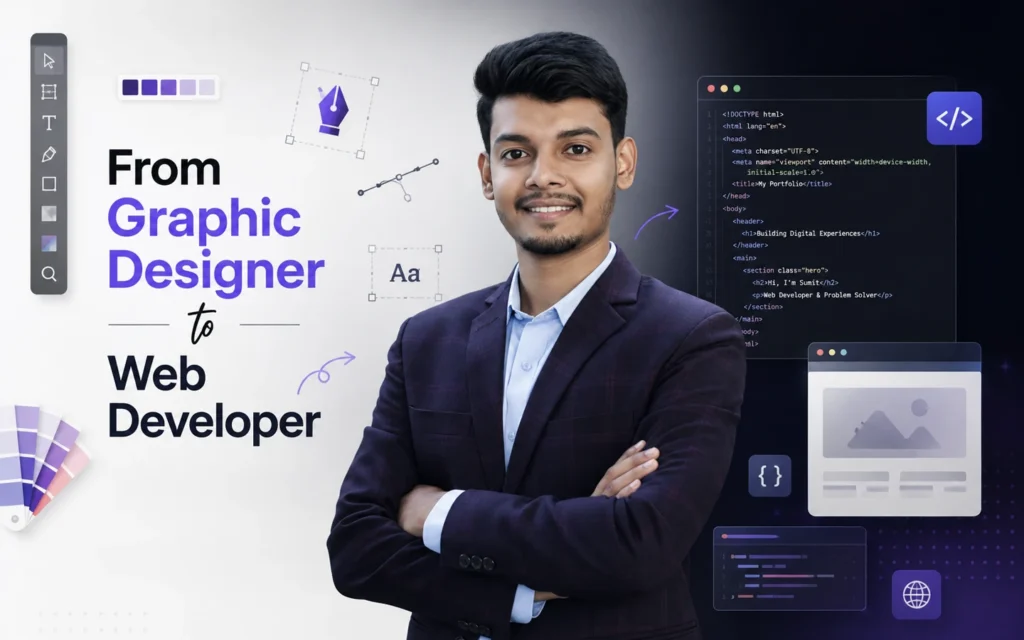
Every career has a starting point, and mine started with graphic design.
When I first began working in the creative industry, my focus was on visuals. I enjoyed creating designs, working with colors, typography, layouts, and finding ways to communicate ideas visually. At the time, I was mainly focused on creating graphics—but over time, I became increasingly interested in something bigger: websites. I started asking myself a simple question:
What if I could not only design the visuals but also build the entire experience?
That curiosity eventually led me from graphic design into web development.
Where It All Started: Graphic Design
Graphic design gave me my foundation.
Before writing code or building WordPress websites, I spent time understanding the principles that make a design work. Things like visual hierarchy, spacing, typography, color combinations, branding, and composition became an important part of how I approached creative work.
Graphic design taught me that good design is not simply about making something look attractive. A good design should communicate clearly.It should guide people’s attention, make information easier to understand, and create a consistent experience. These principles later became extremely valuable when I started designing websites.
When I moved into web development, I realized that a website is much more than a collection of pages. It is a digital experience.
Discovering Web Development
My transition into web development happened naturally. As I worked with different businesses and creative projects, I became more interested in how websites actually worked. I already understood how a website should look, but I wanted to understand what happened behind the design.
I wanted to know:
- How is a website built?
- How does a design become a functional website?
- How can users interact with different elements?
- How can a website work properly across desktop, tablet, and mobile devices?
- How can design and functionality work together?
That curiosity pushed me to start learning web development.
At first, there was a learning curve. Designing a static graphic and building a functional website are two very different things. A website has to look good, but it also needs to be responsive, functional, fast, easy to navigate, and useful for the people visiting it. That challenge was exactly what made web development interesting to me.
Learning to Think Beyond the Visuals
One of the biggest changes in my mindset was learning that a website cannot be judged by appearance alone.
As a graphic designer, I naturally paid close attention to how something looked. But web development taught me to think about what happens after the design.
For example:
- Is the website easy to navigate?
- Can visitors quickly find what they are looking for?
- Does the website work properly on mobile devices?
- Does it load quickly?
- Are the calls to action clear?
- Is the content easy to read?
- Does the website support the overall goals of the business?
These questions changed the way I approached design.
Today, when I work on a website, I don’t think about design and development as two separate processes. I see them as parts of the same experience.
A beautiful website that is difficult to use isn’t successful.
At the same time, a functional website with poor design can struggle to build trust and communicate effectively. The best websites need both.
Why My Graphic Design Background Still Helps Me Today
Moving into web development didn’t mean leaving graphic design behind. In fact, my design background continues to influence almost every website I build.
When I start working on a website, I pay attention to things such as:
Visual Hierarchy
Visitors shouldn’t have to guess where to look.
Through the use of typography, spacing, contrast, and layout, I try to create a clear path that guides visitors through the content.
Typography
Typography can completely change the personality and readability of a website.
Choosing the right fonts and creating a clear hierarchy between headings, paragraphs, and other content helps make a website feel more professional and easier to use.
Spacing and Layout
Sometimes, good design is about knowing what not to add.
Proper spacing can make content easier to understand and give a website a cleaner, more organized appearance.
Branding
A website should feel connected to the rest of a brand.
The colors, typography, imagery, and overall visual style should work together to create a consistent identity.
These are skills I developed through graphic design, and they continue to play an important role in my work as a web developer.
Discovering WordPress
As I continued learning and working on websites, WordPress became an important part of my journey.
What I like about WordPress is its flexibility.
It can be used to build everything from personal portfolios and business websites to blogs and larger, more complex platforms. It also gives business owners the ability to manage and update their content without needing to edit code every time. However, building a good WordPress website requires more than simply installing a theme and adding some content. The real work involves understanding the purpose of the website.
Before starting a project, I try to think about questions such as:
- Who is the website for?
- What does the business want visitors to do?
- What information is most important?
- How should the content be structured?
- What should the user experience feel like?
- How can the website support the business and its marketing goals?
Once those questions are clearer, the design and development process becomes much more focused.
Adding Digital Marketing to the Picture
Over time, my work also introduced me to another important area: digital marketing. This added another layer to how I think about websites.
A website can look professional and function perfectly, but if nobody can find it—or if it doesn’t support the company’s marketing strategy—it may not deliver the results the business expects. Learning more about areas such as SEO, website optimization, content, and digital marketing helped me understand the bigger picture.
A website should not simply exist online. It should have a purpose. For a business, that purpose might be generating leads, selling products, building credibility, sharing information, or supporting a larger marketing strategy.
This is why I now approach websites with more than just design or development in mind. I try to consider how design, functionality, branding, SEO, and marketing can work together.
My Approach to Building Websites Today
Today, when I start a website project, I don’t immediately open WordPress and start designing.
I first try to understand the business.
What are they trying to achieve?
Who is their audience?
What problems should the website solve?
What should a visitor do after landing on the homepage?
From there, I can start thinking about the structure, content, user experience, and visual direction.
My process generally involves:
- Understanding the business and its goals
- Planning the website structure
- Thinking about the user experience
- Creating the visual direction
- Building the website
- Making sure it works across different devices
- Optimizing performance and basic SEO
- Testing everything before launch
Of course, every project is different, and the process can change depending on the client’s needs. But having a structured approach helps me create websites with a clear purpose rather than simply focusing on appearance.
I'm Still Learning
One thing I’ve learned throughout this journey is that technology and design are constantly changing. There is always something new to learn.
New tools, design trends, WordPress updates, development techniques, SEO practices, and technologies continue to change the way we build and experience the web. And honestly, that’s one of the reasons I enjoy this field.
My journey from graphic design to web development hasn’t been about completely changing careers. Instead, it has been about building on what I already knew and expanding my skills.
Graphic design taught me how to communicate visually.
Web development taught me how to turn those ideas into functional digital experiences.
Digital marketing helped me understand how websites can support larger business goals.
Today, all three areas influence the way I approach my work.
Looking Ahead
I started as a graphic designer, but my journey has gradually expanded into web development and digital marketing.
Looking back, I don’t see these as completely separate skills. They are connected. Good branding creates a strong identity. Good design helps communicate that identity. Web development brings the experience to life. And digital marketing helps connect the business with the right audience. That combination is what continues to shape the way I work today.
I still enjoy creating designs. I still enjoy building websites. And I still enjoy learning how technology and marketing can help businesses grow. My journey from graphic designer to web developer is still continuing—and I believe that is the most exciting part.
Final Thoughts
If there is one thing my journey has taught me, it is that your first skill doesn’t have to define your entire career. The skills you learn along the way can become the foundation for whatever comes next.
For me, graphic design was that foundation.It eventually led me into web development, WordPress, SEO, and digital marketing. Each new skill helped me see the bigger picture and changed the way I approach projects.
Today, I don’t just think about how something looks. I think about how it works, who it is for, what problem it solves, and how it can help a business achieve its goals. And that’s the journey that continues to shape my work.
Designing brands. Building websites. Creating digital experiences with purpose.